




Hey there! As a check valve supplier, I often get asked about the flow coefficient of a check valve. So, I thought I'd take a moment to break it down for you in a way that's easy to understand.
First off, let's talk about what a check valve is. A check valve is a type of valve that allows fluid to flow in one direction only. It's like a one - way street for liquids or gases. When the pressure on the inlet side of the valve is higher than the pressure on the outlet side, the valve opens and lets the fluid pass through. But when the pressure on the outlet side tries to push back, the valve closes to prevent backflow.
Now, the flow coefficient, often denoted as Cv, is a measure of how much fluid a valve can pass under specific conditions. It's kind of like the speed limit on a road. The higher the Cv value, the more fluid the valve can handle.
The flow coefficient is defined as the number of US gallons per minute (GPM) of water at 60°F that will flow through a valve with a pressure drop of 1 pound per square inch (PSI) across the valve. For example, if a valve has a Cv of 10, it means that 10 GPM of water at 60°F will flow through the valve when there's a 1 - PSI pressure drop.
Calculating the flow coefficient isn't always a walk in the park. It depends on several factors, including the size and design of the valve, the type of fluid flowing through it, and the pressure conditions. The internal structure of the check valve plays a huge role. A valve with a wider opening or a more streamlined design will generally have a higher Cv value because it offers less resistance to the flow of fluid.
Let's say you have two check valves of the same size, but one has a simple flap design and the other has a more complex poppet design. The valve with the poppet design might have a higher Cv if it's engineered to reduce turbulence and allow the fluid to flow more smoothly.
Another important thing to consider is the fluid itself. Different fluids have different viscosities. Viscosity is a measure of a fluid's resistance to flow. Think of honey and water. Honey is more viscous than water, so it's harder to make honey flow through a valve compared to water. When dealing with a viscous fluid, the flow coefficient of a check valve will be lower because the fluid has a harder time getting through the valve.
Pressure also affects the flow coefficient. As the pressure drop across the valve increases, the flow rate through the valve also increases, but not always linearly. At high pressures, the valve might start to experience cavitation. Cavitation is when the pressure in the fluid drops below its vapor pressure, causing bubbles to form. These bubbles can damage the valve and reduce its flow capacity, which in turn affects the flow coefficient.
Now, let's talk about some of the different types of check valves we offer. We have the Dual Check Valve. This type of valve has two check mechanisms in series. It provides an extra layer of protection against backflow, which is great for applications where preventing contamination is crucial, like in medical or food - processing industries.
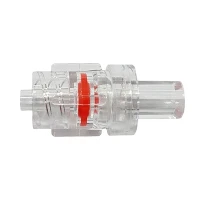
The Luer Check Valve is another popular option. It's designed to be easily connected to other components using a Luer lock or slip fitting. This makes it a go - to choice for applications where quick and secure connections are needed, such as in medical syringes or laboratory equipment.
When it comes to choosing the right check valve for your application, understanding the flow coefficient is key. You need to make sure that the valve you select can handle the flow rate and pressure conditions of your system. If you choose a valve with a Cv that's too low, it might restrict the flow of fluid, causing your system to work inefficiently. On the other hand, if you choose a valve with a Cv that's too high, it might be overkill and more expensive than necessary.
So, how do you determine the right flow coefficient for your needs? Well, it starts with understanding your system's requirements. You need to know the flow rate you need, the type of fluid you're dealing with, and the pressure conditions. Once you have this information, you can use some formulas or consult with an engineer to calculate the appropriate Cv value.
In many cases, it's also a good idea to do some testing. You can set up a test rig with a prototype valve and measure the flow rate and pressure drop under different conditions. This will give you a more accurate idea of how the valve will perform in your actual system.
As a check valve supplier, we're here to help you every step of the way. We have a team of experts who can assist you in choosing the right valve with the appropriate flow coefficient for your application. Whether you're in the medical, industrial, or any other sector, we've got the knowledge and the products to meet your needs.
If you're interested in learning more about our check valves or have any questions regarding the flow coefficient, don't hesitate to reach out. We're always happy to have a chat and work with you to find the best solution for your business. Let's start a conversation and see how we can help you optimize your fluid - handling systems.


References
- Fluid Mechanics textbooks for general principles of fluid flow and valve operation
- Manufacturer's specifications for check valves for detailed information on flow coefficients and valve performance
So, what are you waiting for? Get in touch with us today and let's get your project on the right track!